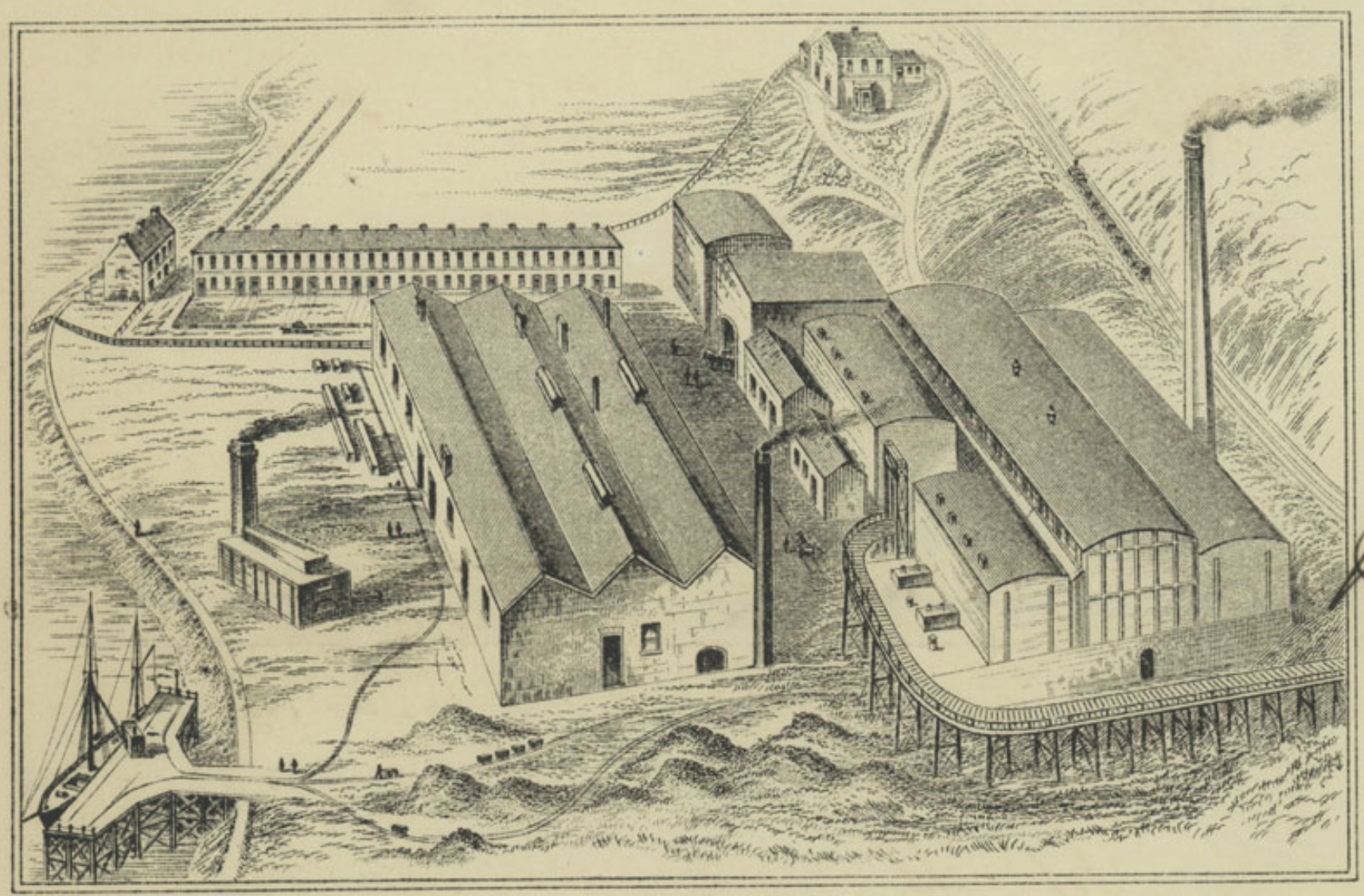
Inauguration & Riverside Economics (1886)
Erected over the course of 1885 and formally inaugurated in January 1886, the South Wales Glass Works introduced high-capacity industrial bottle manufacture to Newport. The opening ceremony was attended by company chairman Mr A. J. Stevens, fellow directors, and the Mayor of Newport, Mr E. J. Grice. Following an inspection of the premises, Mrs Grice was handed a gather of molten glass and blew the ceremonial first bottle to hearty cheers from the assembled crowd. Workmen immediately manned the four furnace apertures, producing various vessels—including the commercial carboy—with remarkable speed.
The strategic rationale for selecting Crindau was articulated at the opening by Chairman Stevens. He noted that escalating railway freight rates were pushing heavy enterprise towards coastal waters, stressing that Newport’s industrial prosperity depended directly on the River Usk. Establishing the plant on the riverside allowed heavy bulk materials like limestone and silica sand to arrive directly by water, bypassing overland railway tariffs.
"Mr A. J. Stevens said that the high rates for railway carriage were causing the diversion of all large industries towards the seacoast. The welfare of Newport depended upon its fine river... Work began at the four openings to the furnace, and bottles of various sizes, including the well known carboy of commerce, were turned out with astonishing celerity."
— South Wales Echo, January 1886
Architecture & Engineering Plant
The works was designed by Messrs Jacobs and Pickwell, civil engineers of Cardiff, who planned the factory sheds, warehouses, and nearby cottages, with operational setup overseen by manager Mr F. T. Woodcock. The primary complex comprised:
Main Production Block: Measuring nearly 200 feet in length by 80 feet in width, this structure housed administrative offices, a workmen's mess room, straw stores, packing rooms, a smiths' shop, and an engineering fitting shop. The workshop was equipped with three heavy-duty lathes, planing machines, drilling tools, and boring gear dedicated to turning and tooling cast-iron bottle moulds.
The Mixing House: Extending over 100 feet in length and powered by an adjacent engine and boiler house, this hall contained a dedicated stone crusher for limestone alongside a grinding mill designed and manufactured in Newport by the Uskside Engineering Company. Flanking storage bays held salt cake, limestone, and two dedicated sand sheds holding up to 1,000 tons of sand, complemented by drying kilns.
Siemens Continuous Regenerative Furnaces
The plant's central feature was its furnace house, built to the designs of Messrs Siemens. Solid fuel was converted into producer gas in dedicated reducers, conveyed through a vaulted brick conduit into valve pits, and directed through pre-heated regenerator chambers.
Mixing with superheated air, the gas burned across the melting baths at temperatures between 3,500°F and 4,000°F. Operating on an alternating 30-minute cycle, waste heat was directed back into secondary regenerators before venting through the stack at just 400°F to 500°F. The two massive continuous tanks held over 90 tons of molten glass each, allowing raw batch to be charged continuously at one end while blowers worked unhindered at the other.
Internal Tramroads, Vertical Lifts & Workforce
Materials moved through the site via a narrow-gauge tramroad network linking the furnace house directly to a river jetty fitted with a steam crane for unloading waterborne ketches on the Usk.
A 16-foot vertical lift raised raw fuel and batch materials from ground level up to an elevated tramway directly servicing the furnace floor. Finished bottles were tempered inside surrounding annealing arches, then lowered by lift to ground-level packing and sorting floors. At peak operation, the facility aimed for an output of 115,000 bottles per week, employing between 200 and 300 men and boys.
Decline and Clearance
Despite the efficiency of the Siemens continuous regenerative tanks in the late nineteenth century, the industry shifted dramatically after 1905 with the introduction of fully automatic suction-feed bottle machinery, such as the Owens machine. As bottle manufacturing consolidated into larger British combines during the interwar years, regional hand-blown works struggled to compete.
Production ceased at the Crindau works, and the brick sheds, annealing arches, and mixing mills were demolished. The ground was cleared and eventually absorbed into twentieth-century railway sidings and municipal depots.